Friday, October 27, 2006

A calculus affair:

The mystery of the renal calculus:
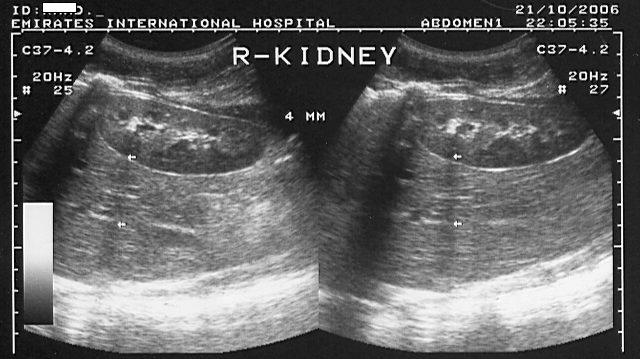
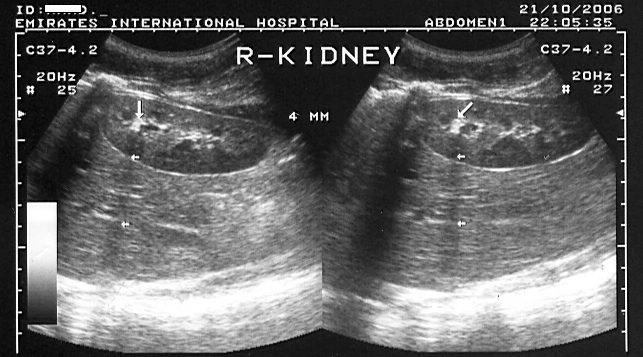
Any sonologist worth his degree would have seen numerous renal calculi or kidney stones. But few would ponder over how many of the minute particles, yes particles, are actually calculi. The problem arises when one begins to diagnose stones of less than 4 mm. This is when the diligent radiologist or sonographer, faces the dilemma of labeling an echogenic structure in the kidneys, a stone or an otherwise normal appearance. Many bytes have been spent on the internet discussing these fine details with my colleagues. The hallmark of the renal or any calculus has always been the bright (echogenic) focus with a trailing acoustic shadow (a dark area behind the stone). As these pictures show, the shadow may not be obvious. In some cases, there may be a faint shadow, which further confuses the sonologist. These images by Dr. Ravi Kadasne, radiologist, in UAE, show a case where there is an echogenic lesion or focus followed by a faint shadow behind it. However, CT scan showed no such calcification or lesion. The best advise in these cases would be to do a follow up of the lesion after a few months.




Friday, October 20, 2006

Chikungunya update:

These bits of information may be useful to those afflicted by the illness:
1) As of 20th October 2006, there have been approximately 50,000 reported cases of this disease in Kerala.
2) It is spread by the Aedes Egypti mosquito, which bites primarily during the day; but in particular, during the dawn and dusk hours.
3) There is no proven effect of papaya extracts or juice as a remedy for Chikungunya. There have been many emails circulating this misinformation.
4) Pregnant ladies must be very cautious and seek medical help if suffering from Chikungunya, specially in the first 3 months (1st trimester).
5) There is no evidence of transmission of the Chikungunya virus via breast milk from mother to infant.
6) It generally takes upto 5 days for the serological tests (blood tests) to reveal the presence of the disease (positive tests).
7) Dengue lasts upto 2 to 3 weeks ; Chikungunya lasts upto 4 to 6 weeks. The joint pain may persist even longer, specially in the elderly patients.

Tuesday, October 10, 2006

DR. Joe Antony

Chikungunya hits Kerala:

A mosquito borne viral fever from East Africa has made it to India. Among the states affected are Rajasthan, Karnataka, Tamil Nadu and Kerala.
Chikungunya is a viral disease spread by the bite of the Aedes Aegypti mosquito, which breeds preferably in fresh water. How did this illness which was last heard of in the outbreak in Reunion island, spread to S. India? No one knows for sure. But it could be due to travel of infected patients from E. Africa. In any case, the Aedes Aegypti mosquito is no stranger to this part of the country. Lack of proper drainage of water is the primary cause for the flare up of this mosquito.
The symptoms of this disease are fever, rashes on the chest and limbs, and most important of all- severe joint pains. In fact, the joint pain and swelling (arthritis) is the hallmark of this ailment. The word Chikungunya means “which makes one bend” in Swahili (an African language). The patients prostrate and crouch due to the arthralgia (joint pain). Chikungunya is self limiting, though it can be fatal.
Treatment is symptomatic- use of antipyretics (for fever) and anti- inflammatory drugs for joint pain (arthralgia). Chloroquine phosphate is being tried in resistant cases.
In Kerala, nearly 100 deaths are attributed to this disease. But in the absence of detailed follow up and pathological studies, the true figures may remain hidden from the people.
The PCR (polymerase chain reaction) serological test remains the gold standard for identifying the disease. This has reportedly an accuracy of nearly 100 %.
Among the leading labs performing the PCR analysis in Cochin, include DDC- international and EI lab.
Chikungunya update: (12th Oct 2006)- 1.3 million cases reported across India.
Cases reported in Kerala- approximately 50,000.

Thursday, September 21, 2006

Diagnostic Ultrasound Gallery

Interested in Ultrasound-- then visit our sister web site:
Diagnostic ultrasound gallery
You'll find loads of ultrasound images with a brief description of each case, links etc.

The crisis facing the small clinic in India:

The small, friendly neighbourhood clinic has for long been the backbone of medical practice in India. But of late, the arrival of large hospitals or multispeciality hospitals is rapidly changing the scenario.
In Cochin, where I work, many of the smaller and even midsized hospitals are feeling the heat, as large hospitals mushroom all over the place. The situation in the field of radiology is also undergoing rapid change. Until 5 years back, independent diagnostic centers ruled the turf of radiology. There were diagnostic centers with CT scan and ultrasound facilities “under one roof”. Then MRI scan was also added to the range of services. When even that was not sufficient, pathology labs were added to these “centers”. Even large hospitals would refer cases to these diagnostic labs. But, soon, these same hospitals decided that, rather than buy the cake, they might as well make it. The result, almost all the major hospitals in town have their own complete diagnostic facilities. The situation is so bad, that some of the independent labs have shut shop or shifted their equipment to greener pastures.
So, what does the future hold for medical practice here. Obviously, many of the numerous labs (and also the smaller hospitals) in this part of the world have to adapt to the changing times; many might simply close shop. Others would merge with the large mega-hospitals, to survive. The friendly neighbourhood clinic, or lab might operate on a part- time basis, with the radiologist operating part time at a number of labs.
The trends one sees in the corporate world will be mirrored in the medical field also.
Kerala, with its high literacy rates (almost 100%) and consequent health consciousness, coupled with inflow of petro- cash (from overseas Indians in the Arab countries), has an abundance of private healthcare facilities. In fact, it is estimated, that, Kerala has one of the highest number of CT scan machines, per unit population in the world. The changes in this microcosm will reflect those in the West and elsewhere.